Four questions your board could ask on Monday
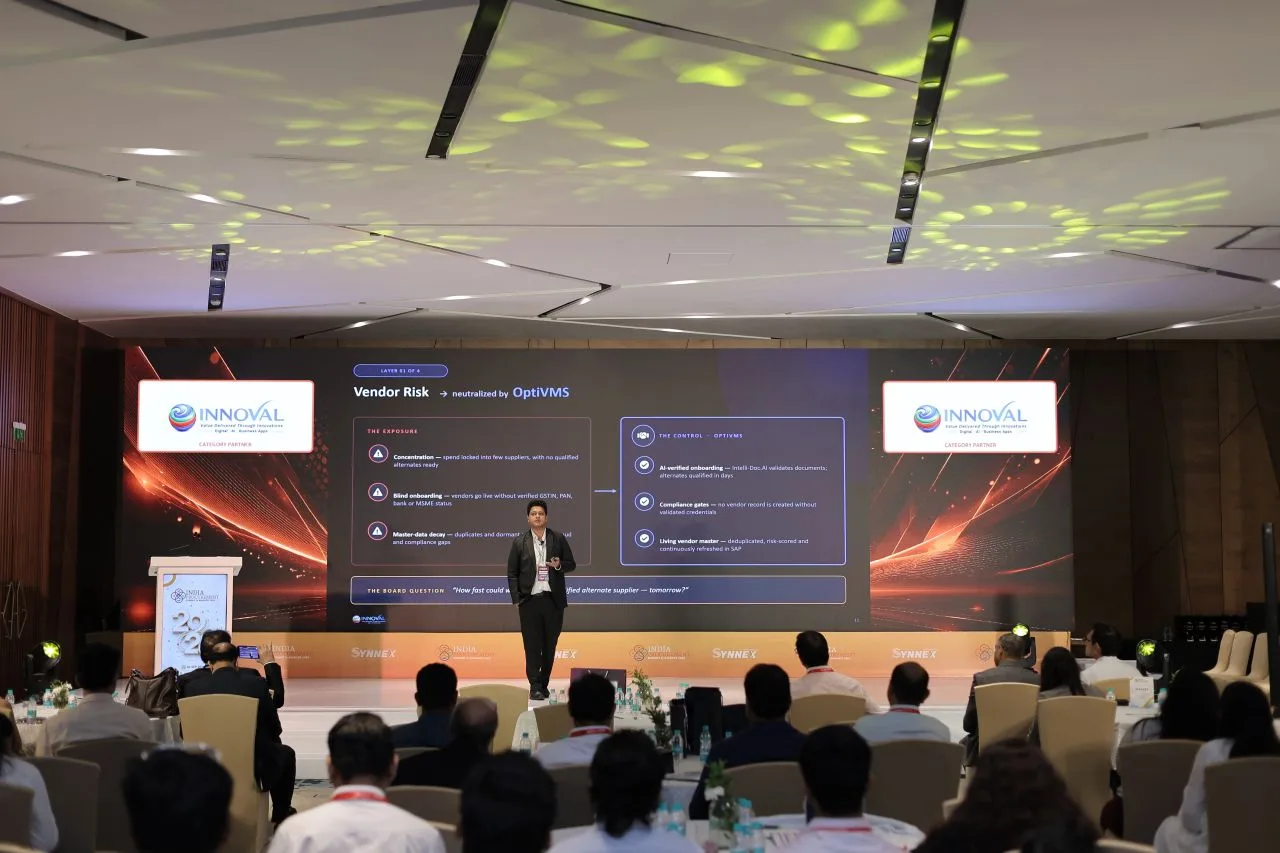
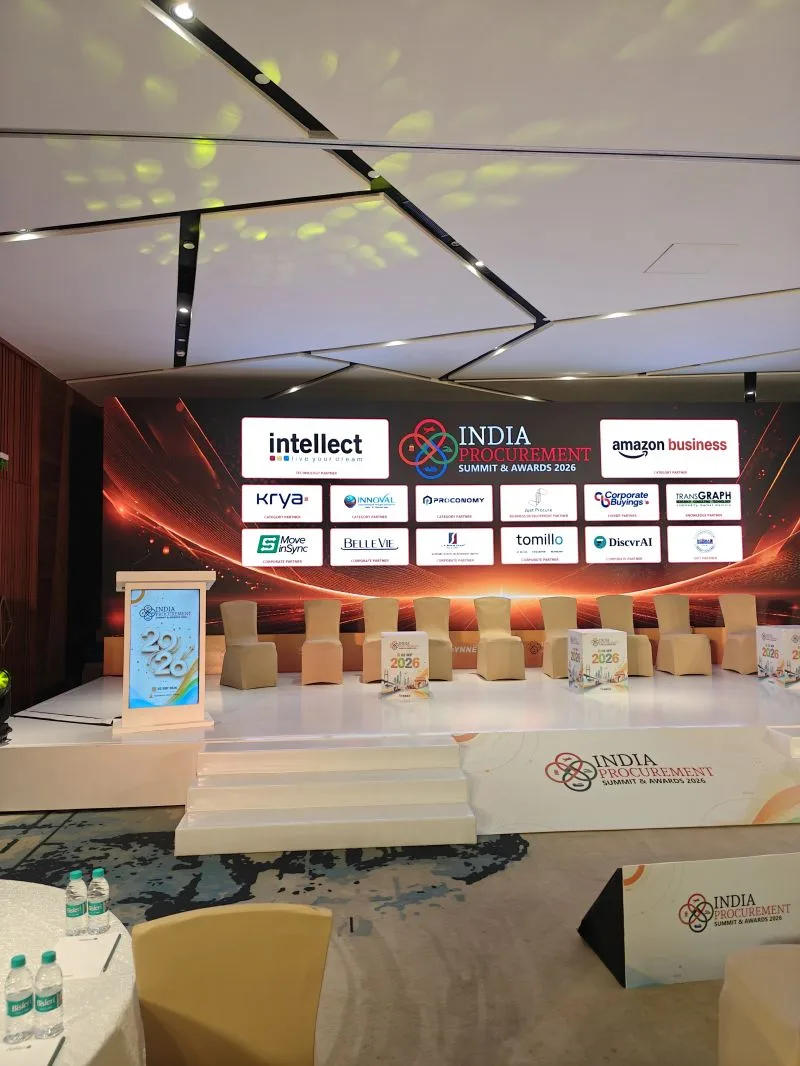
On 2 September 2026 I spoke at the India Procurement Summit & Awards 2026 at the Radisson Blu, Mumbai Airport, where Innoval Digital Solutions was a Category Partner. The summit's theme was connecting leaders and building resilient supply chains, and my session, “Resilient by Design: Building a Risk-Proof Supplier & Trade Ecosystem”, came just before the panel on vendor management in the digital age.
I opened with four questions and asked the room to answer them silently and keep score:
- Vendor: how fast could we stand up a qualified alternate supplier, starting tomorrow?
- Contract: could we produce every executed contract for an auditor by tomorrow morning?
- Trade: how much duty did we overpay last year, and would we even know?
- Cargo: is every shipment in transit right now actually insured, and could we prove it?
If any of those made you pause, that pause is unpriced risk sitting on your balance sheet.
Why resilience fails at the operating layer
Resilience has moved from the strategy deck to the P&L, for three reasons: geopolitical disruption that shifts trade routes faster than supplier networks can follow, regulation that tightens every year (GST, customs, e-invoicing, ESG), and margin pressure that punishes every idle day. Boards have stopped asking "what is our strategy?" and started asking "can our operations actually execute it?"
The uncomfortable truth is that resilience almost never fails in the boardroom. It fails quietly, months later, in operations:
| The strategy says | The operating reality |
|---|---|
| Diversify the supplier base | Onboarding one qualified vendor takes weeks of email chases |
| Enforce contract discipline | Work starts before the wet-ink signature lands |
| Stay ahead of trade regulation | Filings, licences and duty benefits ride on one person's knowledge |
| Insure every movement | Declarations trail the shipment; claims fail for lack of evidence |
Every gap between intent and execution is unpriced risk.
Four risk layers between your PO and your P&L
Across the SAP landscapes we work in, that gap always resolves into the same four layers:
- Vendor risk: who are we exposed to? Concentration, blind onboarding, a decaying vendor master.
- Contract risk: what are we bound by? Unexecuted terms, lost originals, weak evidence in disputes.
- Trade and compliance risk: what does the state require? Filing errors, duty leakage, licence lapses, demurrage.
- Cargo risk: what happens in transit? Uninsured legs, failed claims, premium drift.
And they compound downward: a weak vendor signs a weak contract, ships non-compliant goods, and the loss lands uninsured. You cannot fix the fourth layer by working harder at the fourth layer. Most companies should start at the first.
Layer one: vendor risk, and why it comes first
The exposures are familiar to every procurement team:
- Concentration: spend locked into a few suppliers, with no qualified alternates ready.
- Blind onboarding: vendors go live without a verified GSTIN, PAN, bank account or MSME status.
- Master-data decay: duplicates and dormant records in the vendor master, which is exactly where fraud and compliance gaps hide.
The control is a vendor management system that verifies before it creates. That is what OptiVMS does.
How OptiVMS takes vendor onboarding from 30 days to 2
Vendor onboarding typically takes about 30 days. With OptiVMS it takes about two, not because the chasing is faster, but because the chasing is gone:
- Self-service portal: vendors enter their own company, banking, tax and compliance data and upload their documents.
- Document validation: GST certificate, PAN, bank details and quality certificates are validated automatically, with document intelligence from Intelli-Doc.AI.
- Configurable approvals: multi-level workflows routed by category, value and risk.
- SAP master sync: one approval creates the vendor master in SAP S/4HANA or ECC, with no re-keying.
It connects to what already runs your business: SAP S/4HANA and ECC for vendor-master synchronisation, government portals for GSTIN, PAN and MSME verification, banking networks for penny-drop and IFSC validation, and document management for compliance certificates.
The flow is one governed path in four stages: registration, documents, approval and SAP activation. Your category manager opens one cockpit showing live registrations, pending approvals, expiring documents and compliance alerts. And it is not a parallel system: OptiVMS is a clean-core extension on SAP BTP, working on the same vendor master your team already uses, only governed, verified and current.
The benchmark figures behind "30 days to 2" are about 93% faster onboarding and zero manual SAP master entry. As I said on stage, we validate every one of them against your own baseline before anyone signs anything.
The other three layers, in brief
- Contract risk → [OptiSign](/platform/digital/optisign/): e-execution inside SAP with Aadhaar eSign and DSC, every signed document linked to its SAP transaction, and a tamper-evident trail.
- Trade and compliance risk → [OptiEXIM](/platform/trade/optiexim/): ICEGATE and DGFT filings from SAP data, and every eligible duty benefit flagged before duty is paid. Our EXIM guides cover the schemes in detail.
- Cargo risk → [Opti-Insurance](/platform/trade/optiinsurance/): marine cover declared from SAP shipment data, with claims evidence attached at the source.
Together they form one stack on SAP S/4HANA or ECC: an AI layer on top, the four controls in the middle, and clean-core, upgrade-safe extensions underneath. You can start at any layer.

Fragile today, or resilient by design?
A test you can run on yourself: on how many of these five dimensions are you still on the left?
| Dimension | Fragile today | Resilient by design |
|---|---|---|
| Supplier diversification | Alternates exist on paper; onboarding takes weeks | Qualified alternates live in days, verified |
| Contract enforceability | Wet ink, couriers, missing originals | E-executed, archived, court-ready evidence |
| Customs compliance | Manual filings, broker dependency, queries | Direct ICEGATE and DGFT filing from SAP |
| Duty optimisation | Benefits claimed from memory, or not at all | Every eligible benefit flagged before you pay |
| Cargo protection | Declarations lag; claims fail on evidence | Cover declared automatically; evidence-linked claims |
If you are on the left in three or more, you do not have a technology problem yet; you have a visibility problem.
Same four questions, different answers
I closed by going back to the four questions:
- Stand up a qualified alternate supplier: 30 days becomes 2, with OptiVMS.
- Produce every executed contract: couriers become instant, with OptiSign.
- Know what duty you overpaid: after the fact becomes before you pay, with OptiEXIM.
- Prove every shipment is insured: declarations that lag become automatic, with Opti-Insurance.
None of this is a new system. It is the SAP you already own, with the four gaps closed.
I handed over to the vendor-management panel with one thought: the interesting question is no longer whether we can automate vendor management. It is whether we can prove it.
If you want to run the four questions against your own business, we offer a 45-minute resilience diagnostic: we map your exposures across the four layers, score you on the scorecard above, and quantify what is at risk in duty, demurrage, premium and disputes. Email us at info@ivldsp.com.
Frequently asked questions
What is OptiVMS?
OptiVMS is Innoval's vendor management system for SAP. Vendors register and upload documents through a self-service portal, the documents are validated automatically, approvals follow configurable rules, and the vendor master is created in SAP S/4HANA or ECC without re-keying.
How much faster is vendor onboarding with OptiVMS?
From about 30 days to about 2 in our benchmark, roughly 93% faster, with zero manual SAP master entry. We validate these figures against each customer's own baseline.
What does OptiVMS verify before a vendor is created?
GSTIN, PAN and MSME status through government portals, bank details through penny-drop and IFSC validation, and documents such as GST and quality certificates. No vendor record is created without validated credentials.
Does OptiVMS change the SAP core?
No. It is a clean-core extension on SAP BTP that works on your existing SAP vendor master in S/4HANA or ECC.
What are the four supply-chain risk layers?
Vendor risk, contract risk, trade and compliance risk, and cargo risk. Failures compound from the first layer to the last, which is why most companies start with vendors.